Giving the journey an intelligence of its own.
The problem
Complex organizations are designed around vertical expertise. Finance knows finance. Procurement knows procurement. HR knows HR. IT knows technology. Inside each function the specialization goes deeper: one person may know one system, one policy, one approval, one transaction type, or one stage of a larger process exceptionally well.
The work itself does not respect those boundaries. Hiring an employee, purchasing equipment, establishing a grant, onboarding a vendor, launching a program, resolving a student issue: each of these is a single journey that crosses dozens of people, systems, policies, departments, approvals and handoffs. A complex journey can contain a hundred distinct steps.
Everyone carries a lantern that lights a portion of the road. Almost no one can see the whole of it.
Organizations have experts at every step. They rarely have an expert in the journey.
A process owner may nominally oversee the process, but ownership is not end-to-end expertise. No individual can maintain detailed knowledge of every policy, system, exception, dependency, historical decision and downstream consequence across a large workflow. The result is not poor management. It is a limitation of organizational architecture.
Why the gap persists
It is worth being precise about the cause, because the cause determines the remedy.
The lanterns are bounded because accountability is bounded. Each department is measured on its portion of the road: cycle time inside its queue, errors inside its forms, compliance inside its policy. Nobody's budget, title or performance review depends on the road as a whole, so the road as a whole has no owner. Any department could have walked the full journey at any time. Walking it paid nothing, so nobody walked it.
This matters for what follows. The concept below leans on AI, and AI does make it practical. But AI does not create the will to see the journey. It lowers the cost of seeing it, which removes the excuse not to look. Organizations that adopt this layer should expect it to surface things that were always true and were simply cheaper to leave in the dark.
The missing layer: horizontal intelligence
Most organizational knowledge is structured vertically. What is missing is a complementary horizontal intelligence: intelligence that travels with the work as it crosses organizational boundaries and understands the current transaction in terms of its place in the larger journey.
Horizontal intelligence can know:
• what has already happened, and why the decisions were made;
• what information has already been collected;
• what requirements lie ahead, and which downstream activities depend on today's decision;
• which policies apply, and what similar cases experienced;
• where delays and failures commonly occur;
• which steps may be redundant or unnecessary; and
• what ultimately happened as a result.
Vertical intelligence knows the function. Horizontal intelligence knows the journey.
These are complementary. The objective is not to replace specialists or process owners. It is to connect their expertise across the complete road.
From workflow automation to a Process Companion
Traditional workflow technology answers one question: what happens next? A horizontal intelligence layer can answer a richer one: given everything that has happened, everything we know about this case, and everything that lies ahead, what should we do now?
The user-facing form of that intelligence is a Process Companion. Unlike a chatbot, it persists across the journey. Unlike a workflow engine, it does not simply execute predetermined routing. Unlike a process owner, it holds detailed knowledge spanning every stage. It accompanies the case.
• At Step 5, it recognizes that information required at Step 72 can be collected now.
• At Step 18, it knows the information being requested was already supplied at Step 7.
• At Step 36, it warns that a reasonable-looking decision will create a problem at Step 94.
• At Step 81, it explains why an unusual requirement exists, based on a decision made months earlier.
• Eventually, it asks whether Steps 82 through 87 need to exist at all.
This shifts the role of technology from workflow obedience to workflow awareness.
A naming note: Process Companion is one manifestation, not the thesis. It is memorable, and it sounds like a product. Horizontal Intelligence is the organizational idea. Keeping that order leaves room for process memory, mining, simulation, autonomous intervention and continuous redesign without redefining the original concept.
Two intelligence loops
In-journey intelligence. While a case is moving, the companion guides participants, anticipates downstream requirements, preserves context across handoffs, prevents duplication, flags exceptions and helps people make better decisions. The road becomes easier to travel.
Across-journey intelligence. Every completed journey is evidence. Across hundreds or thousands of cases the organization can ask questions it struggles to answer today. Which steps consume the most time? Which controls actually prevent problems? Which approvals almost never change an outcome? Where is the same information collected repeatedly? Which controls cost substantially more than the risk they mitigate?
The process does not merely execute. It learns about itself.
The two loops have different customers. Participants adopt the first loop because it makes today easier. Leadership pays for the second because it changes the design. The second cannot exist without the first, so the companion has to be useful at Step 5 long before there is enough history to learn from.
Process memory
This requires something beyond a transaction history. A process should remember context, action, rationale and outcome. A system log records that someone approved a transaction. Process memory should explain why the approval was necessary, what informed it, what alternatives existed, what happened afterward, and whether the intervention created value. Over time this becomes an institutional memory that survives departmental boundaries, turnover and system changes.
Of the four fields, rationale is the hard one. Systems already capture actions. Nobody captures reasons, because writing them down is friction. Any workable design either makes rationale capture nearly free (the companion drafts it from the conversation and the person confirms) or accepts that inferred rationale will sometimes be wrong and labels it as inferred. Outcome is the second hard field: for many journeys it arrives months later and attribution is murky. The across-journey loop is only as good as the outcome data the organization is willing to collect.
What already exists, and what doesn't
Parts of this are not new, and the concept should be positioned against them.
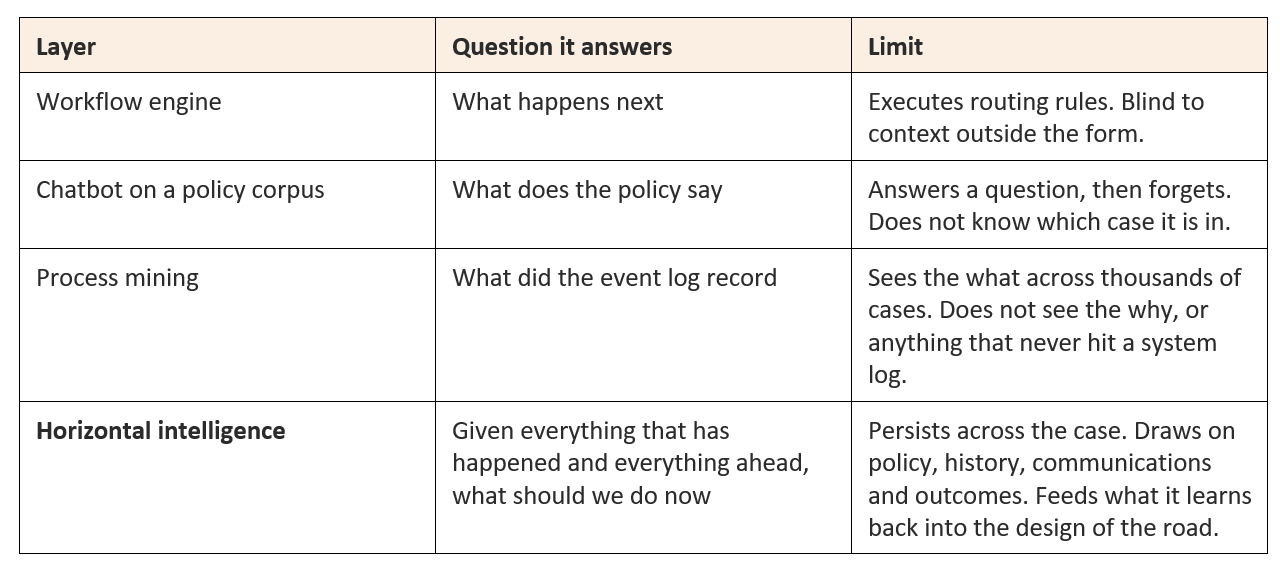
The differentiator is not the learning loop. Process mining tools such as Celonis already do that against event logs, and do it well. Process mining sees the road from above after the fact; horizontal intelligence walks it with the case, carrying the context that never made it into a log. That context is the policy memo, the email thread, the exception someone granted verbally in 2023, the reason the extra signature was added. It is unstructured, scattered and historically too expensive to assemble around a single case. That is what has changed.
The hard parts
A concept memo that only lists the upside is not worth much. These are the constraints that will decide whether horizontal intelligence is deployed.
Authority. The companion can observe that Steps 82 through 87 add nothing. It cannot remove them. Those steps live inside someone's vertical, and that someone approved them. Horizontal intelligence without horizontal authority produces only well-documented frustration. The process owner role needs real power to change the road, or the second loop is inert.
Contribution. The companion knows what the vertical experts teach it. Those same experts will later watch it question their steps. That is an incentive conflict that will need to be managed.
Trust. "This choice will create a problem at Step 94" is a prediction. If it is wrong one time in five, people stop reading the warnings. Downstream dependencies should be sourced from policy text and confirmed history before the companion states them, and it should show its evidence.
The control that never fires. "We have performed this approval 1,800 times and it has never changed the outcome" is a strong line and every auditor will have the same reply: perhaps it never changes the outcome because it deters the bad submission from arriving. Some controls exist for deterrence, and some exist because a regulator requires attestation. The useful question is narrower: which controls exist for outcomes, which for deterrence, which for attestation, and can we show evidence for each?
Data boundaries. A companion that carries a candidate's information from HR into IT and Finance, or a student's from one office to the next, runs directly into the data governance that keeps those verticals separate on purpose. Horizontal intelligence needs a horizontal data agreement.
Cold start. Most of the value on paper is across-journey. Most of the adoption has to come in-journey, from day one, with no history. Pick a journey with volume.
The larger opportunity
AI makes this concept practical because the intelligence no longer has to live in one person's head or be encoded as deterministic rules. Policies, procedures, historical cases, system data, communications, decisions and outcomes can be brought together dynamically around the case itself.
That suggests a different architecture. People and departments retain vertical expertise. The process gains horizontal intelligence.
The opportunity is larger than making existing workflows faster. Once an organization can see an entire process, accompany individual cases through it, remember what happened, and learn across thousands of journeys, it gains the ability to continuously question the process itself. Many organizations are currently automating roads nobody has ever walked end to end.
A Process Companion helps people navigate the road. Horizontal Intelligence lets the organization ask whether it built the right road in the first place.
What would change if every important organizational journey had an intelligence of its own?